Powered By Blogger

Thursday, May 6, 2010

Epilogue #4: Diet and Health


You are what you eat. If we all were aware of the truthfulness of the aforementioned statement, then cardiovascular diseases would not remain one of the prominent causes of death throughout the world.

Nature does require
Her time of preservation, which perforce
I her frail son amongst my brethren mortal
Must give my attendance to.

                                         William Shakespeare

       Thrust into the abundance of convenience provided by the new technologies, the occupants of the modern world are now facing with the scarcity of healthy life style.
Insufficient physical activities, rising pollution, stress and anxiety, processed foods, deficient nutrition intake, obesity, and high blood pressure are but few of the predicaments which are unfortunately quite common these days.


      However, this does not indicate the end for humanity or doom's day for that matter! Despite the fact that more people die of too much food than of too little at the current epoch, we all can bring upon changes to our life styles in order to counter all those negative factors starting by a proper diet.

      The topic diet and health was discussed in our latest Talk Show and specifically with some quotations regarding the theme:


"Don't dig your grave with your own knife and fork." 
 
"I've been on a diet for two weeks and all I've lost is fourteen days." By Totie Fields.
 
"I'm on a seafood diet.  I see food and I eat it!"
 
"You can't lose weight by talking about it.  You have to keep your mouth shut!"
 
"You should not be afraid of heights but instead afraid of widths."
 
"When it comes to eating right and exercising, there is no "I'll start tomorrow."  Tomorrow is disease." By Terri Guillemets.

      We started the classes by asking questions about the general definition of diet which was mostly responded by saying that diet refers to the accustomed habit of food selection and consumption used for a specific purpose. 


      I then demanded the participants to describe their own diets. The answers ranged from diets filled with junk foods and snacks to strict athletic regimens.


Strategies for Weight Loss -- powered by eHow.com


      Unfortunately we all acknowledged the fact that the majority of the class were in dire need of changing their diets for one reason or another.We then discussed the means by which we could improve our diet including :

-Physical activities and exercises on a regular basis.
- Four to six light meals a day instead of two to three heavy ones.
-More water and less salt intake.
-Abundance of fruits and vegetables in the diet.
-Consumption of foods that are rich in fiber.
-Less stress and anxiety.
-Avoidance of processed and fatty foods.
-Reduction of sugar and caffeine from the diet.   

       While improving the diet is one thing, maintaining it, is something entirely different. In this way the students commented that keeping the diet requires substantial determination as well as motivation, especially for the long and hefty diets.

       So in the end we all agree upon the fact that having a healthy diet is only attainable through change of life style, hence if you would rather stay fit, handsome and exuberant you'd better drop those snacks and start jogging.  

Thursday, April 22, 2010

Epilogue #3, Marriage


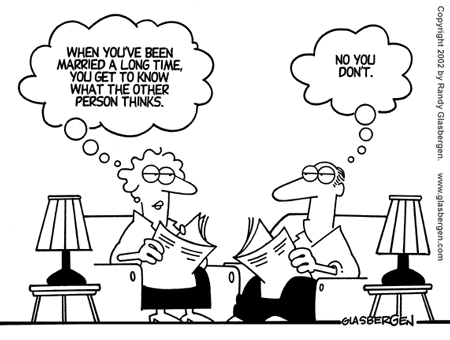
 For one reason or another, we discussed the concept of marriage in our last Talk Show classes. To tell the truth, I personally expected a generally positive attitude towards marriage; however, in action, the results were mixed to say the least.
 
As usual the classes were started by quotations:
 
"Love: a temporary insanity, curable by marriage."
 Ambrose Bierce
  
“To be happy with a man you must understand him a lot and love him a little. To be happy with a woman you must love her a lot and not try to understand her at all.”
  Helen Rowland
 
“Women marry men hoping they will change. Men marry women hoping they will not. So each is inevitably disappointed.”
  Albert Einstein
 
“More marriages might survive if the partners realized that sometimes the better comes after the worse.”
  Doug Larson
 
"I have always considered marriage as the most interesting event of one's life, the foundation of happiness or misery."
George Washington

 
    "Fundamentals of marriage" was the initial point that started the debate among the learners. The principles include: love, communication, respect, shared interest, ability to resolve conflict, accepting changes, trust, shared responsibility, and honesty.


    The participants went on and described the importance of each and every one of the elements. Apart from love that was almost unanimously acknowledged as the chief cornerstone of any kinship that fuels the process of engagement, the second most important aspect for the majority of the student were trust and honesty which can turn the outcome of any relationship based on its availability or lack thereof.

    Although we can not ignore the fact that most believed marriage to be a finite social [and a perpetual spiritual] contract that would not insure anything but a mere official recognition. Thus I asked about the real guarantee for such unions, and the immediate response was love itself. In this way, the younger participants simply dismissed the current traditions regarding marriage and claimed that intimate relationship ought to proceed for years and years before finally evolving into marriage.


How to Create a Successful Marriage -- powered by eHow.com


    We then warned the students with unsound marriage statistics and high divorce rates especially within developing societies. The reason behind such stats is, more often than not, intense emotional attachment that hinders the process of logical thinking.When a relationship enters the stage of marriage before the affectionate passion is subdued, the results are seldom satisfactory.

Fortunately the bulk of married learners were gratified by their marriage and considered a substantial relationship prior to marriage, which is aimed at earning experience and evaluating the partner in the most unbiased manner, the key to a successful future for the couple. 

    Then 12 stages of marriage were narrowly discussed : courtship, living together, marriage , having a family , first child entering the school, last child entering school , first child entering puberty , last child entering puberty, first child leaving the house ,last child leaving the house , becoming grandparents and finally retirement. 

    In the end we realized that while marriage is of vast importance, it not only needs to be chosen wisely, but also demands maintenance and care throughout.


Further Readings :

Two Keys to a Happy Marriage

12 Ways to Have a Happy, Healthy Marriage


How to Maintain a Good Marriage Relationship?


Thursday, April 15, 2010

Epilogue # 2, Literature

Literature as many of you might agree, is a subject that is part of our subconscious lives without us noticing it. The concept of literature was indeed one of the most abstract and difficult topics that we discussed in our last Talk Show.
Many participants announced their lack of knowledge regarding literature right-off-the-bat, and those who actually established signs of interest in the topic were honest enough to admit the ambiguity of the subject matter. 


   So why is literature so laborious for the bulk of the people to define and discuss? Does it imply that literature is no longer considered crucial, and the modern world does not pay enough attention to it? Is it simply due to various alternatives that are brought upon by the new technologies…things such as round-the-clock TV channels and the internet that provide us with the magnitude of information to the point where literature proves unnecessary?

   In this regard I quoted a few statements about literature in our Talk Shows which might enlighten this seemingly rigorous construct :

  • “The difficulty of literature is not to write, but to write what you mean; not to affect your reader, but to affect him precisely as you wish.”
                                                            Robert Louis Stevenson

  • “Books are humanity in print.”
                                                              Barbara W. Tuchman

  • “Literature adds to reality, it does not simply describe it. It enriches the necessary competencies that daily life requires and provides; and in this respect, it irrigates the deserts that our lives have already become.”
                                                                       C.S. Lewis

  • “What is wonderful about great literature is that it transforms the man who reads it towards the condition of the man who wrote.”
                                                                         E. M. Forster


  • "Poetry is at least an elegance and at most a revelation."
                                                                 Robert Fitzgerald

  • “While thought exists, words are alive and literature becomes an escape, not from, but into living”
                                                                    Cyril Connolly


   Most participants agreed upon the fact that literature is a channel through which ideas and emotions are emitted, i.e. one can use literature as a means to use their higher faculties [traits that are exclusive to humanity] in order to express one's notion. A few students actually went on and declared that literature could be even a mean by and of itself.

   Literature takes various forms including but not limited to fiction, non-fiction, poetry, prose, journal, autobiography, biography and many more.

   All classes unanimously agreed that literature affect the lives of every single one of us, and has direct impact on the way we interpret the world, hence the direct link between culture and literature was instituted.

   After discussing the general definition of literature, we then moved on to scrutinize different types of literature. Initially we classified literature in two forms of ancient and modern. Despite the mixed opinions about either forms, Talk Show attendees generally believed that ancient literature is akin to a locked treasure which emanates beams of wisdom from afar ,however can not be fully embraced unless unlocked first. This issue was particularly magnified by the fact that well-known literary works such as William Shakespeare's and Hafiz's need to be deciphered before they reveal their true spirit.


   On the other hand, modern literature, while far more convenient to digest, sometimes can not yield the level of depth that is otherwise achievable through study of old-style composition. This predicament is further amplified by the fact that contemporary authors across the globe [excluding few territories] face with the nonsensical challenges of censorship, financial insecurity, and the hectic phase of modern lifestyle.


   Towards the finis of the classes I asked the learners to cite their favorite genre of literature which, not to my surprise, led to conclusion that romance and fiction are certainly the most sought-after literary genres especially among females!

   In the end, the majority of the participants admitted that their knowledge concerning literature is indeed insufficient, and they realized their imminent need for more literature studies.

Thursday, April 8, 2010

Epilogue # 1, Tradition


Tradition was the topic discussed in the first Talk Show class after the New Year in Iranian calendar. Now the first question that rises in our mind is about the definition of tradition, what does tradition mean?

Let's take a look at some amazing quotes full of insights about tradition, shall we?

Tradition may be defined as an extension of the franchise. Tradition means giving votes to the most obscure of all classes, our ancestors. It is the democracy of the dead.
By G. K. Chesterton

Traditionalists are pessimists about the future and optimists about the past.
By Lewis Mumford.

Traditions are the guideposts driven deep in our subconscious minds. The most powerful ones are those we can't even describe and aren't even aware of.
By Ellen Goodman.

As soon as tradition has come to be recognized as tradition, it is dead.
By Allan Bloom .

Tradition does not mean that the living are dead, but that the dead are living.
By Gilbert K. Chesterton .


Contemplating tradition in a literal manner would grant us with the run-of-the-mill description of the word: a set of belief, customs and pattern of thoughts inherited by an individual from the society of origin. This definition is generally accepted by the majority of people simply because they consider tradition a permanent component of our conscience that regulates our perception and attitude towards the other members of the community and the universe as a whole.


However it raises a few vital questions: can tradition be chosen, altered or even totally disregarded?These questions were brought upon in our latest Talk Show.

The majority of participants believed that tradition while derived from culture can be chosen or dismissed. Generally speaking, the younger learners had a far more negative and pessimistic posture towards tradition and considered it an obstacle to globalization and modernization.

On the other hand, the relatively older students unanimously believed that tradition is the exclusive factor that ultimately distinguishes between cultures and make a community unique, and while not every tradition is to be upheld, some traditions (in case of Iran) such as Nowruz are worthwhile and ought to be preserved.

Almost the entire two classes believed that secular traditions are far more acceptable than non-secular ones and they represented specifically Iranian culture in a more direct manner.

Dr.Ali Reza ,one of my learners, mentioned that tradition can indeed be changed through each new generation, although this process is quite time-consuming.

Overall the reaction towards tradition was relatively negative amongst younger participants and neutral between the older ones. It's quite evident that most Iranians these days seek to choose the traditions that are constructive and rightfully theirs and leave out all the rest.

I personally learned a lot thinking about these deep statements , so what have you gotten out of them ? I'll leave you to contemplate on the issue and realize the actual purpose regarding the severe criticism, remember those societies that have not let go of the tradition are the least developed and most superstitious communities in the world ,finally it's all up to you to decide your orientation.

Tuesday, March 30, 2010

Briefing

Epilogue pertains to the reports that will be posted upon conclusion of each Talk Show class, describing briefly the discussed content along with an analysis by the author.

This section proves immediately beneficial for both the current as well as newly joined learners of Talk Show by yielding a record of the brought upon themes.